


Hurricane Irma prompts school closings in Georgia
News September 10, 2017
 * Union County Schools will be CLOSED Monday, September 11th, 2017 due to Gov. Nathan Deal declaring a state of emergency for all 159 counties in Georgia. Please continue to monitor here for further updates.
- Fannin County Schools will be closed for students and all personnel on Monday, September 11.A great deal of consideration has been given to this decision. Governor Deal has us under a State of Emergency. Severe weather conditions, such as severe winds (especially at higher elevations), debris, dangerous road conditions, and downed power lines are all possible for our area beginning tomorrow(Monday) morning.Weather predictions are not always accurate, but this storm is massive and cannot be ignored. It is my hope that our community is spared from this, but it is better to err on the side of caution when safety is in question. Please stay safe!
- Pickens County Schools closed Jasper, Georgia — Due to inclement weather conditions,the Pickens County School District will be closed tomorrow, Monday, September 11th – TWELVE MONTH EMPLOYEES REPORT AT NORMAL TIME. Schools will also be closed on Tuesday, September 12. Twelve month employess will be contacted late Monday as to whether they will be required to come to work on Tuesday. All school activities, including athletic events and after-school programs, will be canceled. Information will be posted on the Pickens County School District website at www.pickenscountyschools.org, the Infinite Campus parent portal, district and school websites and social media sites, and sent to local media.
* Gilmer County Schools closed Release from Gilmer County School School Closed – Monday, September 11, 2017Gilmer County Schools will be closed Monday September 11 due to Hurricane Irma. We have made this decision after consultation with local emergency management authorities and careful consideration of safety factors, such as the probability of severe winds especially at higher elevations, debris, dangerous road conditions and downed power lines left in its wake. We understand that weather predictions are not always accurate, but this storm is massive and cannot be ignored. It is our hope that our community is spared from the force of this storm, but we will always choose to err on the side of caution when our students’ safety is in question.
* Dawson County Schools Closed Based on information from the NWS, Dawson County Schools will be closed on Monday, September 11, 2017. Twelve month employees report.
* Lumpkin County Schools Closed Due to the weather forecast for our area, Lumpkin County Schools will be closed on Monday, September 11, 2017. The anticipated high winds pose a significant threat to our students and staff. We understand that weather predictions are not always accurate, but we cannot ignore the potentially dangerous situation that this storm poses. Our number one priority is to keep our students and staff safe! Decisions for future closings will be made as more information becomes available. Thank you for supporting Lumpkin County Schools!
* Towns County Schools will be closed Monday for all students and staff. A decision about Tuesday will be made tomorrow afternoon.
* White County Schools Closed Due to the severe weather forecast, White County Schools are closed for students and staff Monday, September 11, 2017. Please be safe!
* Murray County Schools Closed Murray County Schools will be closed Monday September 11 and Tuesday September 12, due to the possible impact of Hurricane Irma. We have made this decision after consultation with local emergency management authorities and careful consideration of safety factors, such as the probability of severe winds, debris, dangerous road conditions, and downed power lines. We understand that weather predictions are often incorrect, but the size of this storm cannot be ignored. It is our hope that Murray County is spared from any of this storm’s impact, but we will always choose to error on the side of caution. All events planned for Monday and Tuesday evenings are also cancelled. This includes the September 11 MCPS Board meeting. This meeting will be rescheduled for Thursday, September 14 at 6:15 p.m. All maintenance, grounds crew, and transportation employees will meet at the transportation office.


Georgia Mountains’ unemployment rate unchanged
State & National June 26, 2017
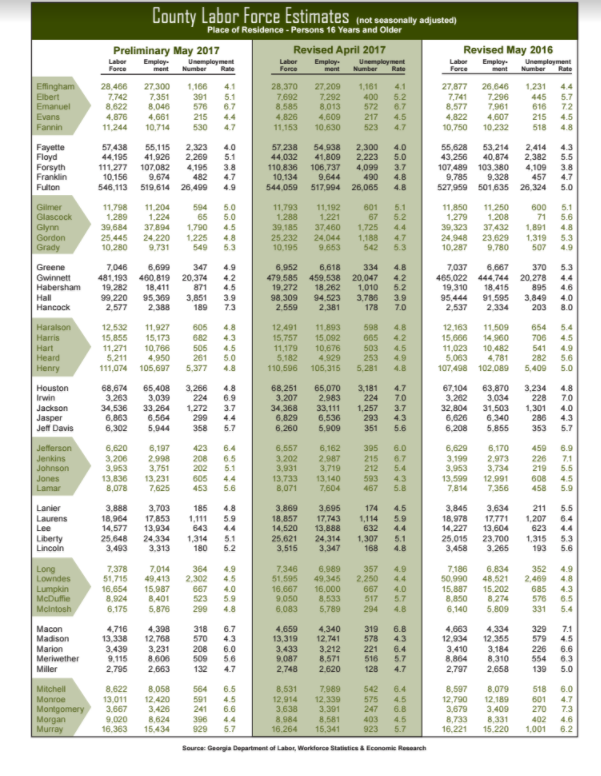
Georgia Mountains’ unemployment rate unchanged at 4 percent in May
ATLANTA – The Georgia Department of Labor (GDOL) announced today that the unemployment rate in the Georgia Mountains region in May was 4 percent, unchanged from April. In May 2016, the rate was 4.2 percent.
While the rate was unchanged, there were 1,854 more Georgia Mountains area residents employed in May than in April, pushing the total number to 322,801. The increase in the number of employed residents in May grew by 10,692 from May 2016.
From April to May, the labor force, which consists of employed residents and those who are unemployed and actively looking for jobs, increased by 1,861 to 336,335. As the number of employed residents rose, the number of unemployed increased by seven to 13,534.
Compared to May a year ago, the labor force had a net increase of 10,593. The number of employed grew by 10,692, and there were 99 fewer unemployed.
The number of initial claims for unemployment insurance, a measure of new layoffs, declined by 397, or 28.5 percent, to 996. Most of the decrease came in manufacturing and administrative and support services. Over the year, claims were down by 743, or 42.7 percent, from 1,739 in May 2016.
Metro Gainesville had the lowest area jobless rate at 3.9 percent, while the River Valley region had the highest at 6 percent.
Meanwhile, Georgia’s seasonally-adjusted unemployment rate for May was 4.9 percent, down from 5 percent in April. It was 5.3 percent in May 2016.
Job seekers and employers are encouraged to use GDOL’s online job listing service employgeorgia.com to search for jobs or recruit new employees. In May, 2,197 new job openings in the Georgia Mountains region were posted on Employ Georgia. Throughout the state, 70,120 new job openings were posted.
Local area unemployment data are not seasonally adjusted. Georgia labor market data are available atdol.georgia.gov
Visit dol.georgia.gov to learn more about career opportunities, Employ Georgia and other GDOL services for job seekers and employers and to connect with us on social media.
DATA FOR THE METRO AREAS ARE ATTACHED, TABLES AND GRAPHS REFLECTING LABOR MARKET DATA ARE AVAILABLE AT http://dol.georgia.gov/current-labor-force-data-and-grants




Op–Ed submitted by Todd Rehm
Opinion June 23, 2017
Georgia is suffering a wave of overdoses as new forms of extremely potent and often deadly drugs make their way into our communities. In fact, a new report by the Agency for Healthcare Research and Quality shows that opioid-related hospital admissions nearly doubled between 2009 and 2014 – the highest rate of the 43 states examined. The Georgia Alliance of Community Hospitals and our 86 members across the state are proud to be part of the first-line of response to these sobering tragedies.
These illegal drugs, which know no geographic, demographic or economic bounds, have changed the way that overdoses come into our hospital emergency rooms and demonstrate the importance of having a robust and resilient network of hospital emergency departments.
Increasingly, overdoses come in clusters of multiple incidences within a short time. The impact on an emergency room can be paralyzing, even for a large Metro Atlanta hospital, much less a smaller facility in a rural market. The impact can also be lasting, as stabilized patients often require prolonged medical support, including intensive care and services from a number of different departments.
On top of this growing epidemic, emergency rooms are also experiencing increased visits related to behavioral or mental health, which have have skyrocketed nearly 60% over the same period. This is in addition to the heart attacks, accidents and other life threatening situations that bring patients through their doors and require a hospital’s full capabilities to treat. This week, Becker’s Hospital Review ranked the emergency rooms with the most visits per year, placing two Metro Atlanta facilities in the top ten nationwide.
As hospitals deal with the strain of increasing admissions, the existence of a strong network of neighboring hospitals helps distribute the patient load and ensure timely access to care. But today, as hospitals across Georgia struggle under the pressure of financial challenges caused by factors including changing demographics, growing numbers of underinsured and uninsured patients, and declining populations – that network is at risk.
For example, it is estimated that Georgia hospitals performed $1.7 billion dollars worth of uncompensated care in 2015 alone, which is simply unsustainable. In addition, potential cuts in Medicare and Medicaid are being discussed in Washington, DC, that would force more hospitals to close their doors, as 7 in Georgia and 80 across the nation have been forced to do since 2010.
One of the keys to the stability of Georgia’s network of care is the state’s Certificate of Need (CON) program. This critical tool helps the state manage the availability and financial survival of safety net hospitals while ensuring access to emergency departments, advanced treatment, and routine healthcare needs. Despite the tenuous status of our current healthcare system, CON continues to come under attack, largely by out-of-state corporate chains whose priorities place financial gain before patient care.
At least five legislative proposals were brought forth during this year’s session of the General Assembly that sought to weaken or repeal the CON laws that protect our healthcare system. Since that time, the Georgia Department of Community Health has considered an additional proposal, but voted to retain the current rules.
Many of the arguments for repealing or weakening CON hinge on the idea that more facilities, offering limited services, will enhance patient choice. But experience proves that these new facilities often choose to offer only the most-lucrative procedures, to the most well-insured patients. This occurs at the expense of existing hospitals, which then lose the benefit of offering profitable services that help cover the cost of much-needed but costly services, such as emergency rooms and trauma centers.
Healthcare markets are different from most “free” markets for goods and services. Consumers often do not understand the true costs of care, nor do they have sufficient information to compare services by different providers or in different facilities.
Simply having more facilities does not equate to greater access for patients. As existing hospitals are weakened financially, sometimes closing as a result, patient choice is actually reduced, while unneeded facilities proliferate in lucrative markets.
Expert testimony recently commissioned by the Georgia Attorney General’s office demonstrated that CON programs can reduce healthcare costs, improve the quality of healthcare services, and expand access to care. Conversely, if existing hospitals are weakened financially, sometimes closing as a result, patient choice is ultimately reduced.
Georgia’s hospital system faces serious challenges, from the rise of opioid overdose clusters and spread of infectious diseases like the Zika virus, to the political and financial challenges emanating from Washington, DC. Preserving and strengthening our front line of healthcare response is vital not only to our health, but to our continuing prosperity as a state. The time could not be worse for weakening protections for our hospital system, which would come at the unquestionable risk of reducing access to healthcare and emergency services.
Monty Veazey is President of the Georgia Alliance of Community Hospitals, a statewide organization of not-for-profit hospitals. He served in the Georgia House of Representatives from 1977 to 1983.
Snowden: A Hero or a Traitor Part ll
Politics, Videos January 10, 2017
Is Snowden a hero or a traitor? The NSA Stellar Wind program violated constitutional rights. Why is an American, who is revealing an illegal program, punished? Edward is still in asylum in Russia. Will Trump compromise with Snowden when Putin hands over Snowden?
State National 9/14/16
GMFTO September 14, 2016
George offers opinions on Obama’s Campaign and America’s threats as well as his Short Moments for GMFTO.
Jennifer Hazelton Talks Trump 9/6/16
GMFTO September 6, 2016
BKP speaks with Jennifer Hazelton, Georgia Communication Director for the Donald Trump Campaign, about the election and campaigns so far.
Georgia is Not in Play
GMFTO August 24, 2016BKP highlights why Georgia will remain a Red State and is “Trump Country.”
Trump Announces New Communication Director In Georgia
News August 16, 2016
Trump campaign named Jennifer Hazelton communication director in Georgia. Hazelton contacted BKP at Fetch Your News to announce she can speak on behalf of the Trump campaign, answer questions, and set up interviews. #trump2016 #georgia #trumpcampaign #2016politics#makeamericagreatagain #fyntv #gmfto #fetchyournews
Convention Round Table 7/27/16
GMFTO July 27, 2016
Georgia Republican Delegate Linda Clary Umberger and Gilmer Republican Party Chairman Stephen Aaron sit down with BKP for a round table discussion about the National Conventions.
Medical Marijuana 6/24/16
GMFTO June 25, 2016
A special segment on Medical Marijuana. BKP meets Rick and Melisa Searcy whose daughter, Angel Searcy, has Cerebral Palsy and Microcephaly. BKP also talks legislation with Dale Jackson from Hope United.
51st District State Senate Candidates on FYN’s Candidate Day
Election, Politics May 23, 2016
Steve Gooch and John Williamson speak on FYN’s Candidate Day for the citizens on the eve of the election day.
